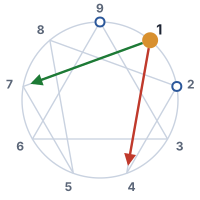
Type 1 in the Enneagram. The red arrow shows the move towards type 4 under stress. The green arrow shows the move towards type 7 in security. The two blue rings mark the wings, type 9 and type 2.
How to recognise type 1
You have a clear sense of how things ‘should’ be.
You notice mistakes and details others overlook.
You have an inner critic that rarely takes a break.
You are responsible, principled and reliable.
You can get irritated when others don’t take responsibility.
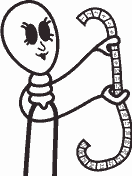
Balder Vendt-Striim teaching type 1. The measuring tape stands for type 1’s eye for how things ought to be.
Your strengths
Type 1 creates quality, order and fairness. They are conscientious, keep their word and raise the standard around them.
Under pressure and in security
Under pressure, type 1 can become self-critical and withdraw emotionally (traits from type 4). In security they let go of control and become more spontaneous and joyful (traits from type 7).
Do you recognise yourself?
All nine types come in three subtypes. Your basic type stays the same, but the subtype colours the whole expression, and this is often where the last doubt is cleared away.
Subtype
Hallmark
Often falls into
Self-preservation
Order, precision, a firm grip on the details
Worry turning into restlessness
Social
Represents the right way to do things
Making your own standard the general one
One-to-one
The urge to reform is aimed at those closest to you — warm and demanding
Turning the ideal into a demand on others
Where are you right now?
Riso-Hudson divides each type into nine levels of development, grouped into three ranges: levels 1-3 are the healthy ones, 4-6 the average and 7-9 the unhealthy. It is not a grade but a state, and you move between them — sometimes over the course of a single day.
Range
How type 1 looks
In good form levels 1-3
You can use your judgement without being judgemental. There is acceptance and a sense of proportion, and others come to you when something needs doing properly — not because you demand it, but because you can.
In everyday life levels 4-6
The ideal becomes a task. You organise, correct and improve, and spend more energy keeping order than enjoying the result. The criticism is inward first, audible later.
Under pressure levels 7-9
The demand becomes relentless. Self-criticism loses all proportion, and the world feels fundamentally wrong. A hardness can set in, towards yourself as well as others.
Each of the nine levels is described in depth by Riso-Hudson. If you want to work with them in depth, we go through them on Enneagram Kurser's courses.
Not sure of your type?
Descriptions can point to several types, a test gives a reliable starting point.
Look at your motivation, not just your behaviour: type 1 is driven by being good, right and having integrity. An Enneagram test like 360indicator gives a valid indication.
What is the core motivation of type 1?
Being good, right and having integrity, and to avoid being wrong, bad or corrupt.
What is type 1 confused with?
Type 1 is most often confused with type 8 and type 9. This is based on our own data: of the 877 users the test suggested type 1 for, 84.4% chose type 1, and the rest most often moved to those two types. A test and a conversation about core motivation help to tell them apart.
What are the wings of type 1?
Type 1 has wing 9 and wing 2, the two types on either side in the Enneagram circle. Most people lean towards one more than the other. A 1 with a 9 wing is calmer, more withdrawn and principled. A 1 with a 2 wing is warmer, more outgoing and concerned with helping others do the right thing. The wings explain why two people of the same type can seem very different.
How does type 1 react under stress and in security?
Under stress type 1 moves towards type 4 and starts to show some of that type's patterns. In security the movement goes towards type 7. This is not a change of type, but sides of yourself that become more visible depending on your state. It is precisely why you cannot read a person's type from behaviour alone.
How do you communicate best with a type 1?
Be precise and keep your promises. Acknowledge what is already right before pointing out the flaws, because a type 1 has an inner critic doing that job already. Sloppiness and vague agreements are the fastest way to lose them.
How often do people choose a type other than type 1?
Among the users who were given type 1 in the full 360indicator profile and took a position on the result, 84.4 per cent confirmed the type. Those who chose differently most often went to type 8, type 9 or type 3. The figures are based on 6,330 completed profiles in 360indicator's own database and describe the people who have taken this test, not the population as a whole.
What do the levels of development mean for type 1?
Riso-Hudson divides each type into nine levels of development, grouped in three ranges: levels 1-3 are the healthy ones, 4-6 the average and 7-9 the unhealthy. It is not a grade but a state you move between. For type 1 it looks like this. In good form: You can use your judgement without being judgemental. In everyday life: The ideal becomes a task. Under pressure: The demand becomes relentless.