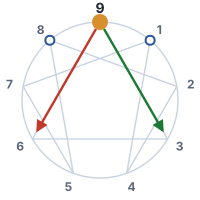
Type 9 in the Enneagram. The red arrow shows the move towards type 6 under stress. The green arrow shows the move towards type 3 in security. The two blue rings mark the wings, type 8 and type 1.
How to recognise type 9
You seek harmony and avoid conflict.
You easily see others’ perspectives.
You can find it hard to prioritise yourself.
You are relaxed and easy to be around.
You can procrastinate and lose focus on what matters.
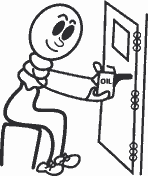
Balder Vendt-Striim teaching type 9. The WD-40 stands for type 9, who smooths things over and removes the friction between others.
Your strengths
Type 9 are open-minded, calm and unifying. They create peace and bring people together.
Under pressure and in security
Under pressure, type 9 can become anxious and suspicious (traits from type 6). In security they become more goal-oriented and energetic (traits from type 3).
Do you recognise yourself?
All nine types come in three subtypes. Your basic type stays the same, but the subtype colours the whole expression, and this is often where the last doubt is cleared away.
Subtype
Hallmark
Often falls into
Self-preservation
Calm in routines and small comforts
The small comforts replacing what matters
Social
Works hard for the community, keeps the group running
Being present in everyone's cause except your own
One-to-one
Merges with the person closest to you, takes on their rhythm
No longer telling what is your own apart from what you have absorbed
Where are you right now?
Riso-Hudson divides each type into nine levels of development, grouped into three ranges: levels 1-3 are the healthy ones, 4-6 the average and 7-9 the unhealthy. It is not a grade but a state, and you move between them — sometimes over the course of a single day.
Range
How type 9 looks
In good form levels 1-3
You wake up in your own life. You can feel what you want and say it without losing the peace. The easy-going quality becomes connected to real presence.
In everyday life levels 4-6
Convenience becomes habit. You adapt, put off what is uncomfortable and keep busy with whatever asks nothing of you. The anger turns into stubbornness.
Under pressure levels 7-9
You disconnect, stop reacting and let the problems grow. It looks calm from the outside, but it is a form of giving up.
Each of the nine levels is described in depth by Riso-Hudson. If you want to work with them in depth, we go through them on Enneagram Kurser's courses.
Not sure of your type?
Descriptions can point to several types, a test gives a reliable starting point.
Look at your motivation, not just your behaviour: type 9 is driven by having inner and outer peace. An Enneagram test like 360indicator gives a valid indication.
What is the core motivation of type 9?
Having inner and outer peace, and to avoid losing connection and creating conflict.
What is type 9 confused with?
Type 9 is most often confused with type 7 and type 2. This is based on our own data: of the 419 users the test suggested type 9 for, 88.1% chose type 9, and the rest most often moved to those two types. A test and a conversation about core motivation help to tell them apart.
What are the wings of type 9?
Type 9 has wing 8 and wing 1, the two types on either side in the Enneagram circle. Most people lean towards one more than the other. A 9 with an 8 wing is more forceful and clear. A 9 with a 1 wing is more principled, orderly and structured. The wings explain why two people of the same type can seem very different.
How does type 9 react under stress and in security?
Under stress type 9 moves towards type 6 and starts to show some of that type's patterns. In security the movement goes towards type 3. This is not a change of type, but sides of yourself that become more visible depending on your state. It is precisely why you cannot read a person's type from behaviour alone.
How do you communicate best with a type 9?
Be calm and give time to answer. Ask directly for their opinion, because they rarely offer it unprompted. Pressure and haste make them withdraw rather than object.
How often do people choose a type other than type 9?
Among the users who were given type 9 in the full 360indicator profile and took a position on the result, 88.1 per cent confirmed the type. Those who chose differently most often went to type 7, type 2 or type 1. The figures are based on 6,330 completed profiles in 360indicator's own database and describe the people who have taken this test, not the population as a whole.
What do the levels of development mean for type 9?
Riso-Hudson divides each type into nine levels of development, grouped in three ranges: levels 1-3 are the healthy ones, 4-6 the average and 7-9 the unhealthy. It is not a grade but a state you move between. For type 9 it looks like this. In good form: You wake up in your own life. In everyday life: Convenience becomes habit. Under pressure: You disconnect, stop reacting and let the problems grow.