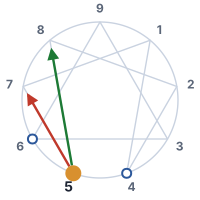
Type 5 in the Enneagram. The red arrow shows the move towards type 7 under stress. The green arrow shows the move towards type 8 in security. The two blue rings mark the wings, type 4 and type 6.
How to recognise type 5
You want to understand how things work in depth.
You need time and space for yourself.
You conserve your energy and engagement.
You observe rather than act impulsively.
You can feel drained by too much socialising.
Balder Vendt-Striim teaching type 5. The binoculars stand for type 5, who observes from a distance before stepping in.
Your strengths
Type 5 are analytical, independent and insightful. They see connections and think clearly under pressure.
Under pressure and in security
Under pressure, type 5 can become scattered and restless (traits from type 7). In security they become more action-oriented and present (traits from type 8).
Do you recognise yourself?
All nine types come in three subtypes. Your basic type stays the same, but the subtype colours the whole expression, and this is often where the last doubt is cleared away.
Subtype
Hallmark
Often falls into
Self-preservation
Builds walls. Keeps needs small, protects the calendar
Independence leaving no room for anyone
Social
Finds its place through knowledge and a professional community
Mistaking knowing something for belonging
One-to-one
Looks for the one person to share everything with
An expectation of intimacy that is never said out loud
Where are you right now?
Riso-Hudson divides each type into nine levels of development, grouped into three ranges: levels 1-3 are the healthy ones, 4-6 the average and 7-9 the unhealthy. It is not a grade but a state, and you move between them — sometimes over the course of a single day.
Range
How type 5 looks
In good form levels 1-3
You step out of your head and into the world. The insight gets used rather than just collected, and you discover you have more to give than you thought.
In everyday life levels 4-6
Preparation replaces participation. You gather knowledge, keep your distance and wait until you feel ready enough. Energy is rationed, and feelings are handled at arm's length.
Under pressure levels 7-9
The isolation becomes self-reinforcing. The world feels intrusive, and your thinking can run off the rails with no corrective from outside.
Each of the nine levels is described in depth by Riso-Hudson. If you want to work with them in depth, we go through them on Enneagram Kurser's courses.
Not sure of your type?
Descriptions can point to several types, a test gives a reliable starting point.
Look at your motivation, not just your behaviour: type 5 is driven by being competent and knowledgeable. An Enneagram test like 360indicator gives a valid indication.
What is the core motivation of type 5?
Being competent and knowledgeable, and to avoid being helpless, overwhelmed or depleted.
What is type 5 confused with?
Type 5 is most often confused with type 9 and type 1. This is based on our own data: of the 597 users the test suggested type 5 for, 86.8% chose type 5, and the rest most often moved to those two types. A test and a conversation about core motivation help to tell them apart.
What are the wings of type 5?
Type 5 has wing 4 and wing 6, the two types on either side in the Enneagram circle. Most people lean towards one more than the other. A 5 with a 4 wing is more creative and emotionally coloured. A 5 with a 6 wing is more loyal, practical and concerned with security. The wings explain why two people of the same type can seem very different.
How does type 5 react under stress and in security?
Under stress type 5 moves towards type 7 and starts to show some of that type's patterns. In security the movement goes towards type 8. This is not a change of type, but sides of yourself that become more visible depending on your state. It is precisely why you cannot read a person's type from behaviour alone.
How do you communicate best with a type 5?
Give them information and time in advance. Do not demand answers on the spot. Respect that they withdraw in order to think; it is not rejection.
How often do people choose a type other than type 5?
Among the users who were given type 5 in the full 360indicator profile and took a position on the result, 86.8 per cent confirmed the type. Those who chose differently most often went to type 9, type 1 or type 6. The figures are based on 6,330 completed profiles in 360indicator's own database and describe the people who have taken this test, not the population as a whole.
What do the levels of development mean for type 5?
Riso-Hudson divides each type into nine levels of development, grouped in three ranges: levels 1-3 are the healthy ones, 4-6 the average and 7-9 the unhealthy. It is not a grade but a state you move between. For type 5 it looks like this. In good form: You step out of your head and into the world. In everyday life: Preparation replaces participation. Under pressure: The isolation becomes self-reinforcing.